
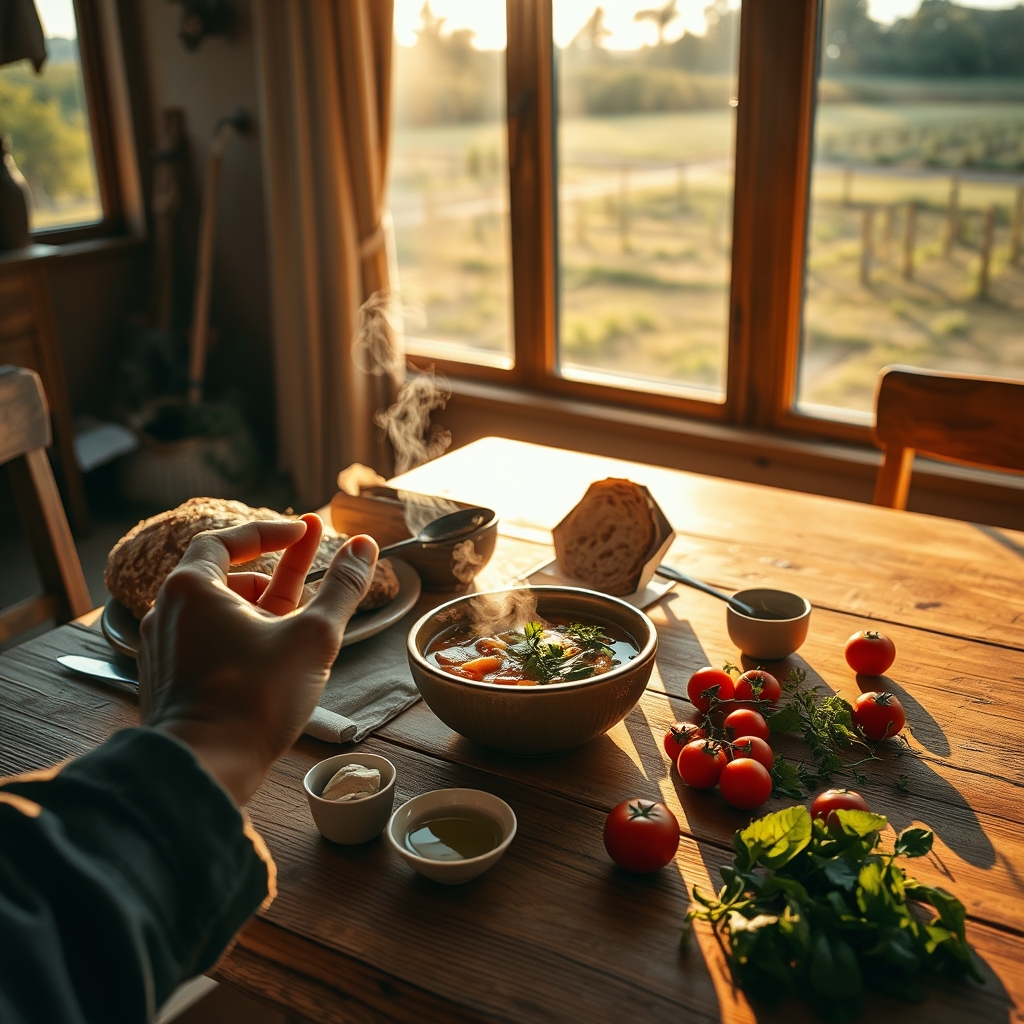
There is a quiet magic in the way a meal arrives at the table—not just in the sizzle of garlic hitting hot oil, or the steam rising from a bowl of soup, but in the invisible threads of intention woven into every stir, every chop, every pause to taste. Nutrition is often spoken of in the language of macros and micros, of vitamins and minerals, of fuel and function. But what if the most vital nutrient we consume is not something we can measure in milligrams or count in calories? What if it is, instead, the quality of our attention—the way we meet the food that meets us?
The Sacred Pause Before the First Bite
Consider the moment before you eat. Do you reach for your fork with the same absentminded urgency as you scroll through a screen? Or do you allow yourself a breath, a heartbeat, a sliver of silence to acknowledge the journey that brought this food to you? The hands that planted the seeds, the sun that coaxed them from the earth, the rain that quenched their thirst—all of it, distilled into this single, fleeting act of nourishment. To eat without pausing is to miss the threshold between hunger and fulfillment, the liminal space where gratitude takes root.
Mindfulness at the table is not about perfection. It is not about eating slowly every time, or never allowing distraction to creep in. It is about the willingness to return—to return to the weight of the fork in your hand, to the texture of the food against your tongue, to the quiet dialogue between body and soul. In that return, there is a kind of alchemy. The meal becomes more than sustenance; it becomes a conversation, a communion, a small but sacred ritual of care.
The Stories Our Food Carries
Every ingredient has a story, and every story carries a vibration. The apple plucked from a backyard tree hums with the memory of summer afternoons and the laughter of children who once climbed its branches. The rice simmered in coconut milk whispers of monsoon rains and the hands that threshed it under a golden sun. Even the most ordinary meal is a tapestry of time and place, of labor and love, of the earth’s generosity and human ingenuity.
When we eat without awareness, we consume these stories blindly, like a book read in the dark. But when we pause to trace the origins of our food—when we ask not just *what* we are eating, but *where* it came from and *who* made it possible—we begin to nourish ourselves in a deeper way. We feed not just the body, but the imagination, the empathy, the sense of connection that binds us to the world. A meal becomes a bridge, spanning the distance between isolation and belonging.
The Body as a Landscape of Listening
Nutrition is often framed as a set of rules: eat this, avoid that, count these, limit those. But the body is not a machine to be programmed; it is a living, breathing landscape, shaped by seasons and storms, by periods of drought and sudden abundance. To listen to the body is to learn its language—the way it signals hunger not just in the stomach, but in the mind’s fog or the heart’s heaviness; the way it speaks of satiety not just in fullness, but in clarity, in lightness, in a quiet hum of contentment.
This kind of listening requires trust. Trust that the body knows what it needs, even when those needs defy the latest dietary dogma. Trust that a craving for salt might be the body’s way of asking for minerals, or that a sudden aversion to meat might be its way of signaling a need for rest. To nourish ourselves well is not to impose a rigid structure, but to cultivate a relationship—one of curiosity, of respect, of gentle attunement.
The Ripple Effect of Nourishment
What we eat does not exist in a vacuum. Every choice we make at the table sends ripples outward—into the soil, the water, the air, the lives of those who grow and harvest and transport our food. To eat with awareness is to recognize that nourishment is not just a personal act, but a collective one. The hands that feed us are not just our own; they are the hands of farmers and fishermen, of bakers and butchers, of the earth itself, offering its bounty with quiet generosity.
When we choose foods that are grown with care, that honor the land and the people who tend it, we participate in a cycle of nourishment that extends far beyond our plates. We become part of something larger—a web of life, a story of reciprocity, a testament to the idea that what we feed ourselves can either deplete or enrich the world around us. In this way, every meal becomes an opportunity to practice not just self-care, but world-care.
The Unseen Harvest of Attention
There is a harvest that comes from eating with attention, one that cannot be weighed or measured. It is the harvest of presence—the way a meal shared in silence can feel more intimate than one filled with chatter; the way a simple bowl of soup can taste like a feast when eaten with gratitude. It is the harvest of memory—the way the scent of roasting vegetables can transport us to a grandmother’s kitchen, or the taste of ripe peaches can evoke the lazy heat of a childhood summer.
These are the nutrients that do not appear on nutrition labels, yet they feed us in ways that are just as vital. They remind us that nourishment is not just about what we put into our bodies, but about how we meet the world—with open hands, with a curious heart, with the willingness to be transformed by the act of feeding ourselves. And perhaps, in the end, that is the most profound nutrition of all: the quiet, daily practice of turning the ordinary into the sacred, one bite at a time.
The table is set, the meal is ready. The question is not just what you will eat, but how you will meet it—with haste or with reverence, with distraction or with devotion. The choice is yours, and the ripples of that choice will shape not just the body you inhabit, but the soul you become.
You may also like
-
The Whispering Palette: How the Colors on Our Plates Paint the Canvas of Our Well-Being
-
The Hidden Dialogue: How Our Plates Speak in the Language of Longing and Fulfillment
-
The Breath Between Bites: How Nourishment Becomes a Sacred Pause in the Rush of Living
-
The Dance of Nourishment: How Each Choice Composes the Melody of Our Days
-
The Echoes of Nourishment: How the Food We Choose Resonates Through Time