
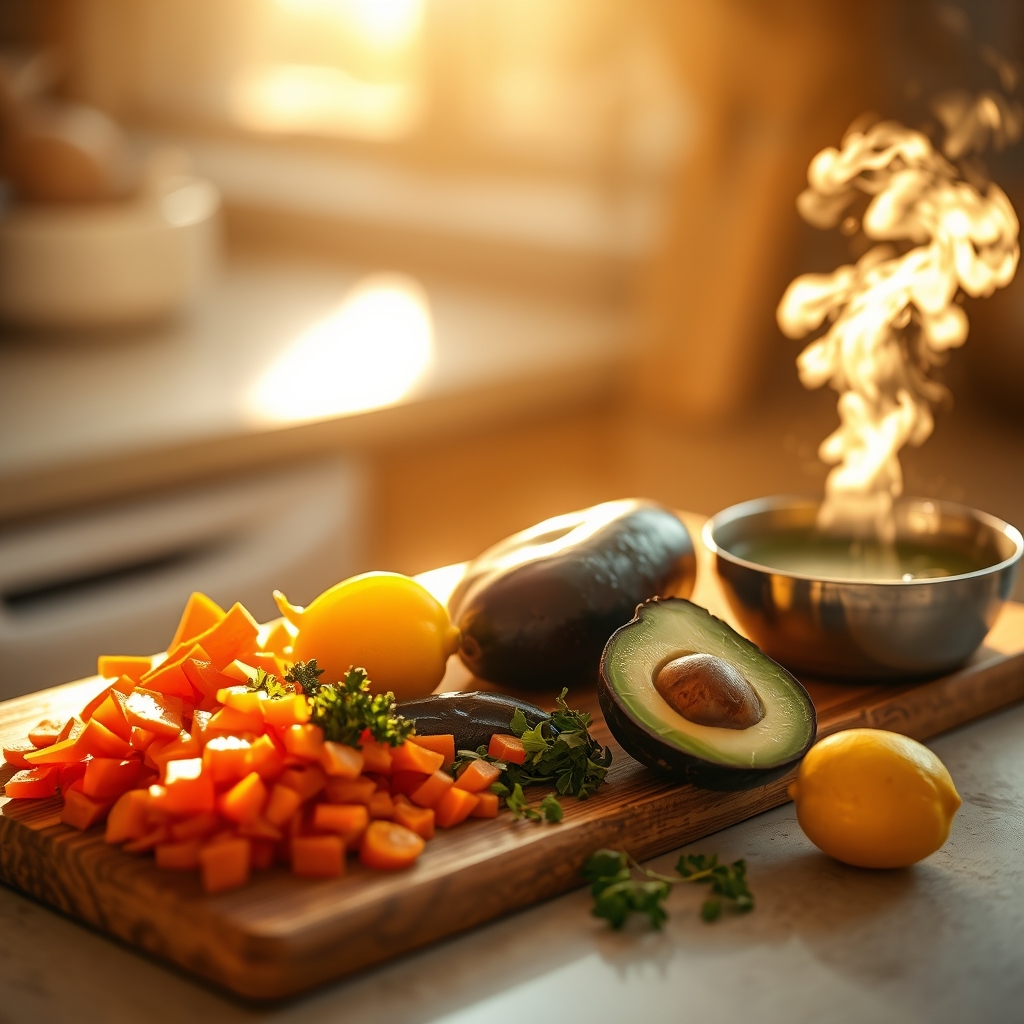
The first light of dawn spills across the kitchen counter, gilding the edges of a ripe avocado, the curve of a lemon, the deep purple of an eggplant. There is a quiet magic in these moments—when the world is still half-asleep, and the act of preparing a meal becomes a sacred ritual. It is not merely about feeding the body; it is about tending to something deeper, something that hums beneath the skin, a hunger that no calorie count can satisfy.
The Alchemy of Attention
We live in an age of distraction, where meals are often consumed in haste, between meetings or in front of screens, the flavors dulled by the noise of the world. But what if we paused? What if we allowed ourselves to truly see the food before us—the way the light catches the seeds of a pomegranate, the way steam rises from a bowl of soup like an offering? Mindful nourishment is not a diet; it is a practice of presence. It is the art of slowing down enough to notice the way a carrot snaps between your fingers, the way ginger burns just a little on the tongue, the way a handful of almonds can taste like earth and sunshine.
Science tells us that eating slowly improves digestion, that chewing thoroughly allows the body to absorb nutrients more efficiently. But beyond the mechanics, there is something almost spiritual in the act of savoring. It is a rebellion against the rush, a small but profound way of reclaiming our time, our bodies, our lives. When we eat with intention, we are not just consuming food; we are consuming the labor of the earth, the hands that planted and harvested, the sun and rain that coaxed life from the soil. There is gratitude in that awareness, a quiet reverence for the interconnectedness of all things.
The Language of Cravings
Our bodies speak to us in whispers and sometimes in shouts. A sudden desire for dark chocolate might be the body’s way of asking for magnesium. A craving for salty foods could signal an electrolyte imbalance. But how often do we listen? In our haste to label foods as “good” or “bad,” we forget that cravings are not moral failings—they are messages. They are the body’s way of communicating its needs, its imbalances, its longings.
Learning to interpret these signals requires patience, a willingness to sit with discomfort rather than immediately reaching for the nearest fix. It means asking, What am I truly hungry for? Sometimes, the answer is not food at all, but rest, or connection, or a moment of stillness. Other times, it is a specific nutrient, a vitamin, a mineral that the body is calling for. The key is to approach these cravings with curiosity rather than judgment, to see them as clues rather than flaws.
The Poetry of Preparation
There is a reason why so many of us find solace in the kitchen. The act of chopping vegetables, of stirring a pot, of kneading dough—these are meditative practices, a way of grounding ourselves in the present moment. The knife becomes an extension of the hand, the cutting board a canvas, the ingredients a palette of colors and textures. Cooking is not just a means to an end; it is an end in itself, a creative expression, a way of infusing love into something tangible.
When we cook for ourselves, we are saying, I am worth the time. It is an act of self-care, yes, but also an act of resistance. In a world that often feels chaotic and out of control, the kitchen is a place where we can exert agency. We can choose the ingredients, the flavors, the methods. We can make something beautiful and nourishing, not just for the body, but for the soul.
The Myth of Perfection
We are bombarded with images of flawless meals, of perfectly portioned plates, of bodies sculpted by rigid diets. But nourishment is not about perfection; it is about balance. It is about listening to the body’s wisdom, honoring its needs, and sometimes, indulging its wants. A life spent chasing an ideal is a life half-lived. The true art of nourishment lies in flexibility, in the ability to adapt, to enjoy, to forgive.
There will be days when the only thing you can manage is a bowl of cereal, and that is okay. There will be days when you crave nothing but sugar, and that is okay too. The goal is not to adhere to a set of rules, but to cultivate a relationship with food that is rooted in kindness and awareness. It is about finding joy in the act of eating, in the flavors, the textures, the memories that food evokes. It is about understanding that nourishment is not a destination, but a journey—one that is as much about the soul as it is about the body.
The next time you sit down to a meal, take a moment to breathe. Look at the food before you, really look at it. Notice the colors, the shapes, the way it glistens under the light. Take a bite, and let the flavors unfold slowly on your tongue. Chew, savor, swallow. And then, perhaps, you will understand that nourishment is not just about what you eat, but how you eat it. It is not just about the food on your plate, but the life you bring to the table.
You may also like
-
The Whispering Palette: How the Colors on Our Plates Paint the Canvas of Our Well-Being
-
The Hidden Dialogue: How Our Plates Speak in the Language of Longing and Fulfillment
-
The Breath Between Bites: How Nourishment Becomes a Sacred Pause in the Rush of Living
-
The Dance of Nourishment: How Each Choice Composes the Melody of Our Days
-
The Echoes of Nourishment: How the Food We Choose Resonates Through Time